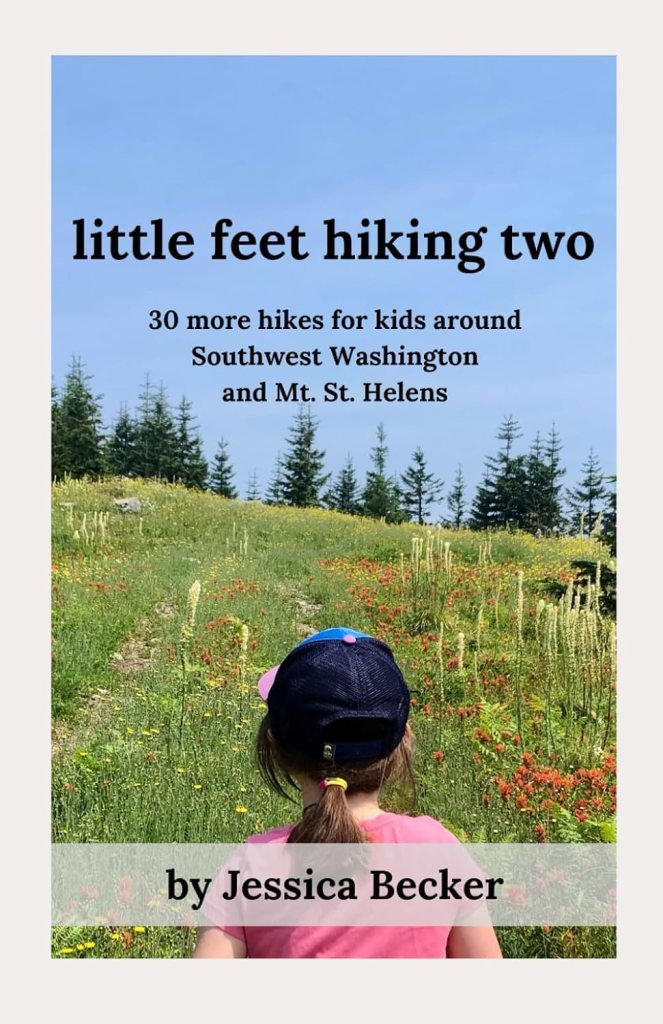
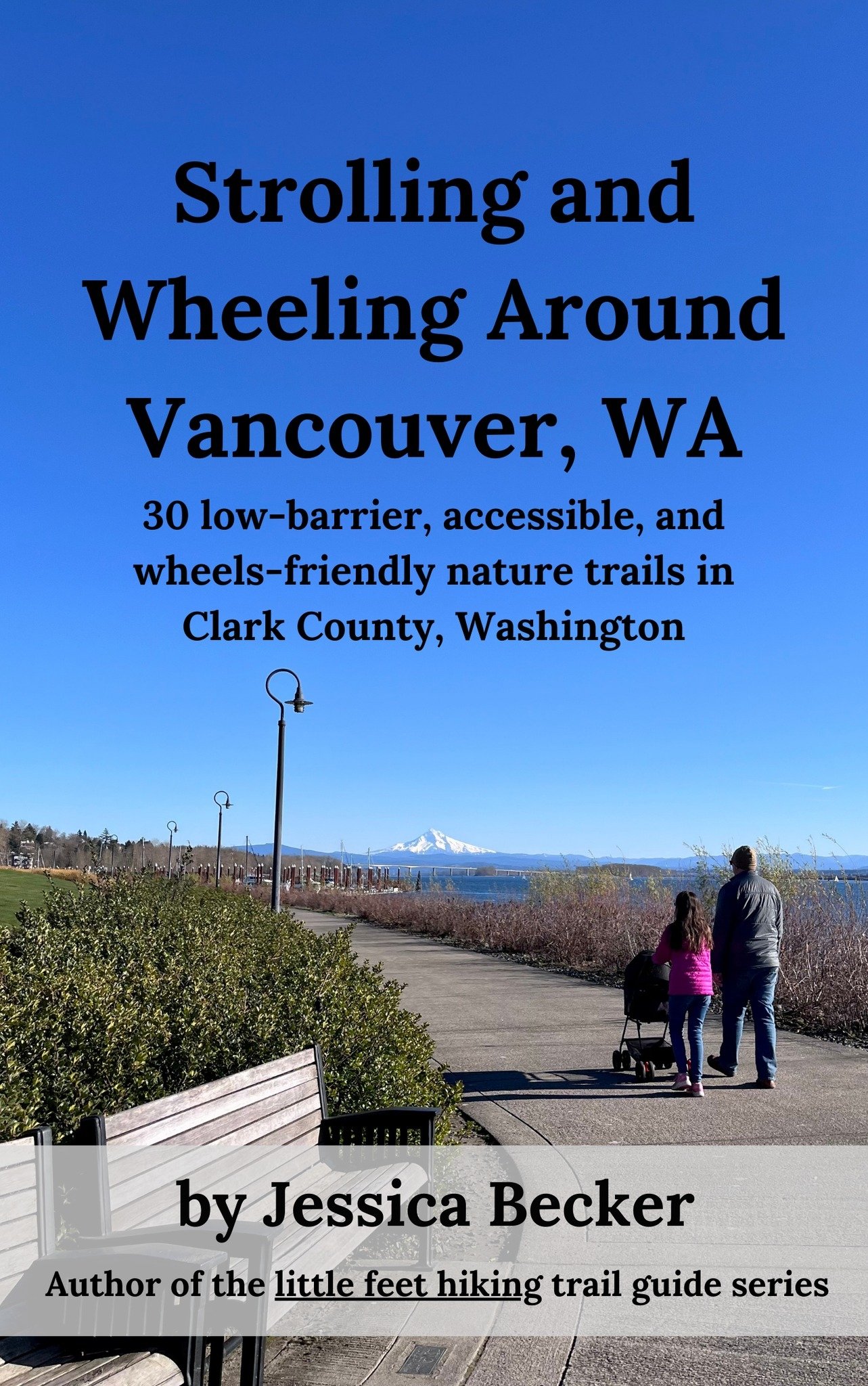
Read on for the 4/21/25 write-up about my newest book from the Lower Columbia Nature Network (LCNN)! You can also find the post here. The LCNN is a great resource – be sure to check out their website and sign up for their newsletter!
“Everyone deserves access to nature, and I wanted to remove a barrier for as many people as possible.”
— Jessica Becker
Jessica Becker is a local homeschooling mom, experienced hiker, outdoor educator, and hike leader. Jessica has published five hiking guides for kids for the Oregon and Washington areas, and she has now published the only low barrier and wheels-friendly trail guide for the Vancouver, Washington area.
Strolling and Wheeling Around Vancouver, WA includes 30 low-barrier, accessible, wheels-friendly trails located in Clark County, Washington. Each trail has been scouted multiple times, and the author provides the most comprehensive trail description you will find anywhere. Each trail description provides information on distance, trail surface and accessibility, restrooms, toddler- and kid-specific risks, safety considerations, interesting things about the trail, specific ways to engage with that particular trail, and more. With this guide, the author uses her decades of experience to help you have the safest and most enjoyable trail outing with families of all ages and mobilities.
We asked Jessica what led her to writing this book. Here’s what she shared.
I wrote this book for many reasons:
I’ve been researching local trails for a decade now, and I have never come across a resource that accurately and completely assesses trails from a kid-friendly, wheels-friendly, or low barrier perspective. Incomplete or inaccurate sources not only creates safety issues, but also comfort issues.
I hike regularly with friends and family with limited mobility, and I have also had moments when I was considered to have low mobility. I need nature connection with loved ones, so knowing where I can walk safely and comfortably is so important.
Over the years, I’ve led a lot of hikes where strollers or bikes were a preferred method of travel for kids (including for my daughter!). There are more stroller-friendly trails out there than most parents realize, so I wanted a guide to show them where they could get out into nature.
I don’t have any personal experience with mobility devices like wheelchairs, but I wanted to include them in this book. While many organizations are including accessibility in their trail descriptions, I found through my research that the information was still lacking or downright inaccurate. Everyone deserves access to nature, and I wanted to remove a barrier for as many people as possible.
Books can be purchased at Vintage Books in Vancouver or on Amazon. If anyone has questions or ideas for Jessica, including a desire to collaborate on a project, please contact her at littlefeethiking.com.
With so many families out hiking, I wanted to post my book’s safety tips so that everyone can see them. While this post does not address everything you need to know about safely hiking with kids, I hope it gets you started.
SAFETY IDEAS:
Below are my most important safety recommendations to prepare for a hike:
ALWAYS, ALWAYS, ALWAYS tell someone where you are going, when you will be back, and if you can, tell them what authorities to contact if you do not check in by the time you say you will. I usually assume one mile per hour and often add an hour or two in case I decide to stay a little longer on the trail or make a stop on the way home.
Try not to hike alone if you are outside of cell service range.
Respect fire closures! More is written on this below.
Give your kiddo a backpack with gear or at the very least, a whistle with a lanyard that goes around the neck. Talk to them about what to do if they get lost (more on this later in this section).
Pay attention to how far in you have hiked and be prepared to carry your kiddo back if you hike in too far or someone gets injured
Keep yourself and your kiddo dry, fed, and hydrated
Know what the weather is supposed to be for the next few days and plan for inclement weather (it changes quickly in the Pacific Northwest); visit www.weather.gov and type in the closest town to your hike and then click on your hike location to get the most accurate weather information
Know your route to the trailhead, including alternate routes and check conditions before you leave, including 48-hour weather forecasts
Know where to find the closest gas station to the trail and what cell service is like
Pre-read the hike descriptions so you know what to expect.
Bring as many of the 10 essentials for you and your kids as you can and know how to use them in an emergency (I write more about this below).
In addition to the above tips, here are my suggestions on how to stay safe while on the trail.
The big things parents can advise kids on are:
Not to put anything in their mouths except for food you have given them
Not to run ahead out of sight
Stop at all trail junctions (where two or more trails come together)
Walk slowly and mindfully when conditions are steep, rocky, downhill, or wet
Stay on the side of the trail away from cliffs and look in the direction they want to hike
Do not run, jump, skip, or hop near ledges or on rocky trails
I advise parents to:
Be prepared and consider possible hiccups
Carry a quality first aid kit and know basic first aid skills; consider carrying an emergency locator beacon
Know your and your kids’ abilities (and how far you can push them)
Be willing to turn around
Go with others (which saved me on the day I sprained my ankle a half mile from the trailhead on Mt. St. Helens!)
Stop at all trail junctions to orient and review maps and hike descriptions before proceeding; you can involve kids in this early on so this becomes a habit
Point out toxic plants and advise on consequences if appropriate
Remember that temperatures will be cooler at higher elevations
Rivers and Lakes:
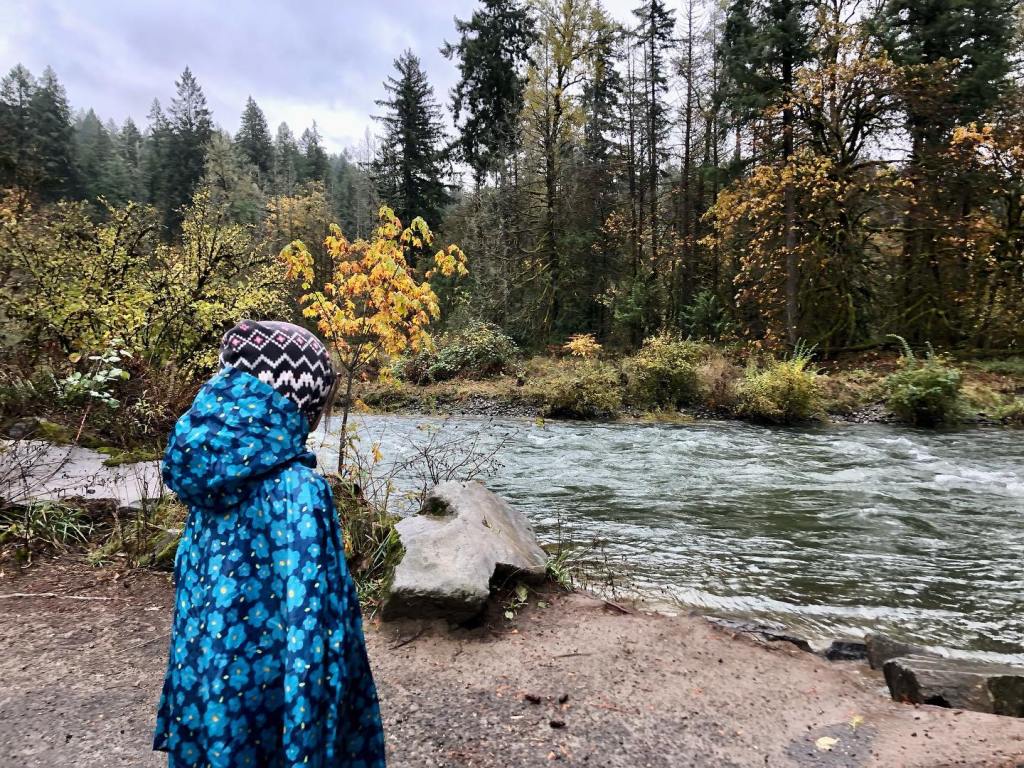
It is important to know that the rivers and creeks in the PNW are swift and cold, and the lakes range from cold to warm depending on the time of year. There are usually no lifeguards and extra care needs to be taken near water, especially around fast-moving rivers and creeks.
Insects:
You will encounter different insects depending on when you visit the areas in the PNW. In general, mosquitoes seem to be less of a problem near rivers, but you should always be prepared to encounter them, especially if hiking near still water. In late summer, you may encounter stinging insects like wasps and hornets. Use caution around the bases of trees and keep an eye out for nests and an ear out for buzzing. You may encounter ticks, especially east of the Cascade Locks area. I have encountered them west of Cascade Locks. It’s always good to do a tick check after every hike, but especially in the spring and year-round hiking east of Cascade Locks. It is a quick and easy habit to prevent having to remove one later. You can learn more here: https://americanhiking.org/resources/ticks.
Toxic Plants:
There are many plants in the woods that are toxic. However, once you start looking into it, most of the plants in your yard are as well (like rhododendrons and rhubarb leaves)! Poison hemlock, many mushrooms, chokecherry, baneberry, and nightshade are some deadly plants you should know about. These plants are not too prevalent, but they do occur in Pacific Northwest forests. I recommend familiarizing yourself with these and other toxic plants. Many plants have colorful berries in late summer and if ingested, will make kids ill but are not necessarily deadly. I have a “no picking of berries” rule. There are some wonderful edible wild berries, but I have instructed my kiddo to point out the berries, ask if they are edible, and then I advise from there. We also have a “no touch” policy on mushrooms.
Dogs:
When meeting dogs on the trail, I have kiddos step off the trail and wait for dogs to pass. Kids should only approach dogs after asking you and the owner if it is okay. Kids should stand above dogs and not kneel down at eye level.
Wild Animals:
You probably know that there are wild animals in the woods (cougars, bears, coyotes, deer and elk, oh my!). Attacks by wild animals are rare in Oregon and Washington, but if you are on a trail where you might encounter these animals, make sure you do not hike alone with your child, make noise, and avoid trails early in the morning and at dusk. This is another reason not to let kiddos run ahead on sparsely populated trails. You can mitigate this by having more than one adult who can take the lead while another adult acts as a caboose. Read up on what to do if you encounter a variety of wildlife here: www.dfw.state.or.us/wildlife/living_with and consider carrying bear spray, whistles, and hiking poles to help scare away an animal.
Lost Kids:
While uncomfortable to discuss, getting lost can happen. Your entire family can avoid getting lost by staying on the trail, carrying a map, and stopping at all trail junctions to confirm that you are where you think you are. Include children in checking maps and identifying your location.
It is important to talk to kids at home and at the beginning of the hike on how to avoid getting lost and what to do if they get lost. Strategies for preventing a lost child include:
Not letting kids run ahead out of sight (tell them they have to stay close enough to see an adult)
Not letting kids leave the trail without an adult
Giving kids a whistle that hangs from a lanyard
Dressing kids in bright clothing
Discussing the importance of stopp
You can also prepare them for being lost by teaching them the following:
Only blow your whistle if you need help (instead of for play)
If you get lost, hug a tree, stay put, and call out or blow your whistle 3 times in a row every few minutes.
It is much easier to find someone who is lost if the only people moving are the searchers
How to use what is in their pack and even practice at home
If your kids get lost, you can aid in their recovery by giving them a backpack to wear with extra food, water, and clothing, a small first aid kit, a flashlight, a large garbage bag or poncho (for raincover) and a notecard with emergency contact information.
It can be scary for kids to talk about getting lost, but discussing how to avoid getting lost and what to do if you get lost is very empowering for kids. Check out this website: https://westvalleysar.org/wilderness-safety/hug-a-tree. Don’t be scared, be prepared!!
GEAR IDEAS:
It is best to plan for “a day hike gone bad,” especially if you will be on a trail without cell service or one that is far away from resources.
When leaving for a hike, I don’t leave the house without:
The 10 Essentials (see below)
Personal Locator Beacon and Garmin Inreach
Physical road map (because cell service is not always available and mapping services are not always reliable)
Bear Spray
Change of clothes and extra socks
Food and water for the trip home
So what are the 10 Essentials and why do people talk about them so much? The 10 Essentials are the top ten things you should need to survive a night out in the woods. They are:
Navigation – map, GPS, compass
Light – headlamp or flashlight with extra batteries
Sun protection – sunglasses, sunscreen, sun-protective clothing like a hat
First aid kit (make sure to include insect repellant and children’s medications)
Knife or multi-tool
Fire – matches, lighter, magnesium/flint
Shelter – tarp, emergency blanket
Extra food – bring more than you need and consider lightweight high-calorie protein bars
Extra water – bring more than you need and consider carrying water purification tablets and/or water filter or lifestraw
Extra clothes – for warmth, bring a hat and a warmer layer; I pack my bag for overnight temperatures
Regarding clothing, I dress kiddo in bright colors so I can keep a better eye on her amongst the colors of the forest. Remember that “cotton kills” in our climate during the rainy months (check this site out for more information: https://sectionhiker.com/why-does-cotton-kill). For a typical November day, I layer my kiddo with synthetic base layers (long underwear), fleece pants, fleece pullover and then a waterproof trail suit or rain jacket and rain pants. Wool is a natural alternative to fleece if you are not sensitive to it like me. You will need to keep an eye on whether your kiddo is sweating and de-layer before that happens (check in after climbing a bit or if you feel yourself getting too warm). Getting wet is a no-no in winter here (see the link above about cotton). These rules apply to socks too. When temperatures are warmer, I tend to stick with wicking clothing for quick drying if kiddo sweats or plays in water. Remember that warm days can still have cool mornings and evenings so always bring warmer layers when hiking in the mountains. Check out this link for good ideas: https://raisinghikers.com/how-to-dress-kids-for-winter-hikes/.
Sun protection is also super important all year long due to the angle of the sun in our Oregon sky. Sturdy well-fitting shoes with good traction are important but dedicated hiking shoes can assist when trails are wobbly or rocky. Bring a pair of kids sandals if you think they might want to play in boggy lakes.
If you can, get your kiddos their own backpacks and water bottles/bladders. This will make hiking even more exciting! Have your kiddos carry their own snacks, water, and layers, but make sure not to weigh them down with too much gear. Experts disagree, but a good rule of thumb is that kids over 4 years old can carry 5-15% of their body weight. Remember to account for the weight of water and the pack itself. For younger kids, you can just let them wear their backpacks with nothing in it to get them used to it.
A single toy or doll to accompany your kiddo on the hike can always be a fun motivator and source of comfort. Bring extra clothes, snacks, and water for the ride home. A travel potty, extra socks,towels, and wet wipes for wiping off trail dirt are always a great idea. You may want to bring a backup kid carrier on your hike if you think you might need to carry your kiddo out.
I will also be getting copies to Vintage Books , but that will take a few weeks.
A little about the book…
Are you looking for low barrier, accessible trails? How ’bout trails where your family can use strollers, bikes, wheelchairs, scooters, wagons, or other wheels? Have you grown skeptical about the information you find on free, online trail resources? Well, look no further.
Jessica Becker is a local homeschooling mom, experienced hiker, outdoor educator, and hike leader. Jessica has published five hiking guides for kids for the Oregon and Washington areas, as well as a low barrier trail guide for the Vancouver, Washington area. Strolling and Wheeling Around Vancouver, WA is the author’s sixth trail guide. This guide includes 30 low-barrier, accessible, wheels-friendly trails located in Clark County, Washington. Each trail has been scouted multiple times, and the author provides the most comprehensive trail description you will find anywhere. Each trail description provides information on distance, trail surface and accessibility, restrooms, kid-specific risks, safety considerations, interesting things about the trail, specific ways to engage with that particular trail, and more. With this guide, the author uses her decades of experience to help you have the safest and most enjoyable trail outing with families of all ages and mobilities. The Vancouver, Washington area has an amazing amount of accessible nature trail opportunities – this is the time to get out and enjoy them!
We all spend a lot of time indoors during our wet Pacific Northwest winters. However, with the right gear and knowledge, you can make winter one of your favorite hiking seasons. Trails are less crowded, migratory birds are in the area, and waterfalls are full. That said, weather can be unpredictable, trails can be muddier, and there may be road hazards.
little feet hiking books have some great information on hiking in the winter. Read on for mom-tested tips on where to hike with kids in the winter, as well as ideas on how to hike safely with kids. Remember that you don’t have to travel far from home or spend a ton of time hiking to make it worthwhile. Even a short hike during the winter can be restorative and meaningful!
For winter hiking with kids, it can be good to stay lower in elevation, closer to cell service, and away from fire-damaged areas. It’s also a great idea to:
Plan for quickly changing weather. Check the weather the morning of your hike, but make sure you have extra layers for rain, wind, or hail. Consult WTA’s snow depth map when looking for snow conditions on a trail. Stay out of the forest when high winds are forecasted (rain plus wind can equal trees falling on roads and/or trails).
Dress in layers and avoid cotton. The combination of cold temperatures and rain can easily put you (and especially kids) in hypothermia territory.
Learn more about winter hiking from the Washington Trails Association (WTA).
Now that you’ve learned a bit on how to hike in the winter, how do you know where to hike with your family? Thankfully, I’ve compiled my favorite winter hikes by book. Check them out below!
Winter may feel a bit sleepy, but the jogging stroller friendly trail at Steigerwald takes you through an area busy with lots of wildlife. On any given winter day, you could encounter deer, birds of prey, ducks, geese, insects, and more. There are also Mt. Hood and Columbia River views. You can hike as little as 2 miles round trip to get a great nature experience, but there are also miles to add on once you connect to the Columbia River Dike Trail. This trail is a family favorite – just be prepared for the possibility of lots of wind while hiking here.
Hike 9 in little feet hiking:Ridgefield National Wildlife Refuge – Oaks to Wetlands Trail
Winter is the best time to visit the refuge because of all the migratory birds! You don’t have to walk very far on this easy 2 mile out-and-back trail to see and hear the noisy and beautiful swans that flew south (to our area) for the winter. Along the trail, you may even come across deer, birds of prey, ducks, and more. Bring a pair of binoculars and be sure to stop to read any interpretive signs. Consider a drive on the nearby Auto Tour Route to see even closer-up views of winter waterfowl and birds of prey. There is a fee to park.
Hike 16 in little feet hiking: Bells Mountain Trail from Cold Creek Day Use Area
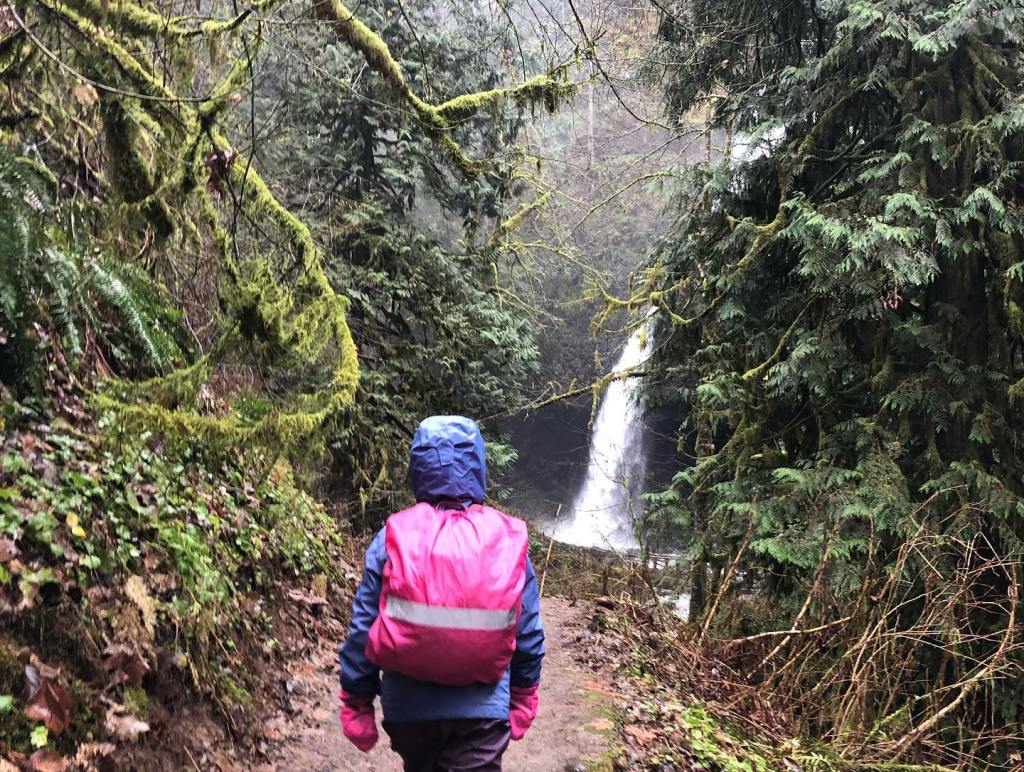
This hike in the Yacolt Burn State Forest is only 27 miles from downtown Vancouver, yet it feels like it is deep in the wilderness. I love this trail in the winter because there is such a deep forest feel that is even more special in the rain. There is so much green from the trees that you totally forget that the skies are gray, and the sound of the rushing creek is quite soothing. The trailhead is down a gravel road, and there is no cell service, so you’ll need to plan to be a little off the grid. A WA Discover Pass is required to park.
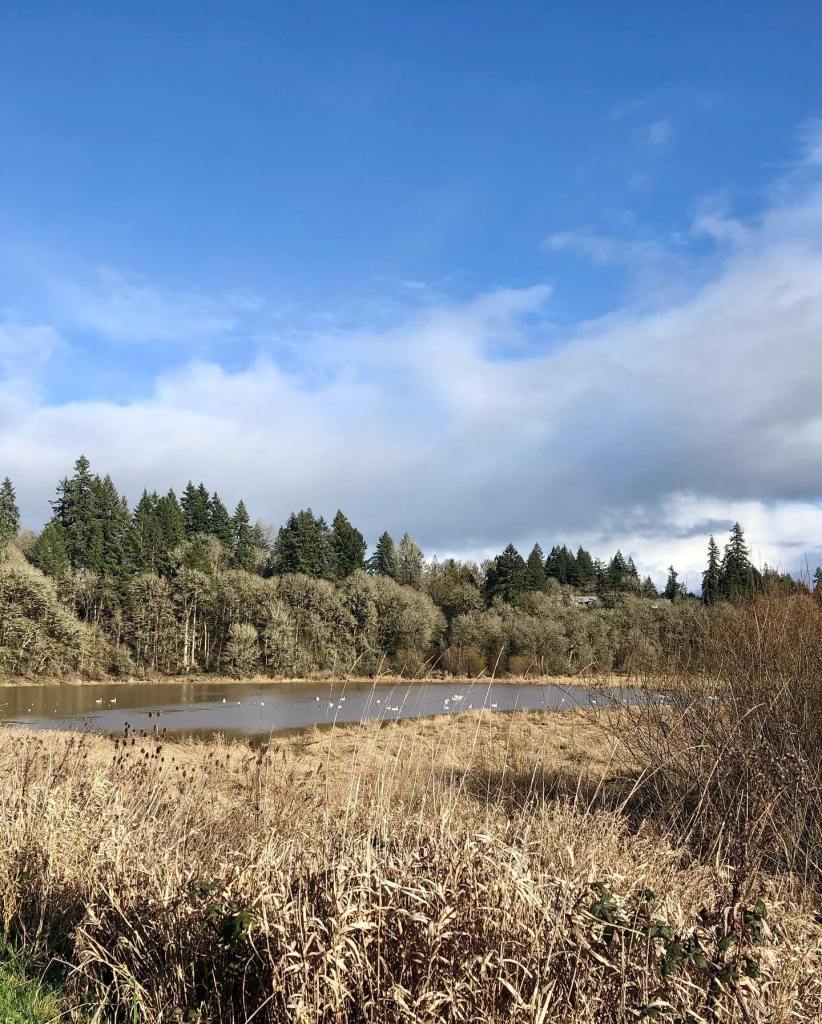
La Center Bottoms is an excellent place for birdwatching, especially for migratory swans and pintail ducks. The trail can be a little muddy, especially when the gravel/dirt trail turns to dirt after the first half mile. You can continue on a dirt trail for another half mile for a 2 mile total round-trip hike. Favorite parts of this trail include multiple bird blinds and fun statues near the trailhead.
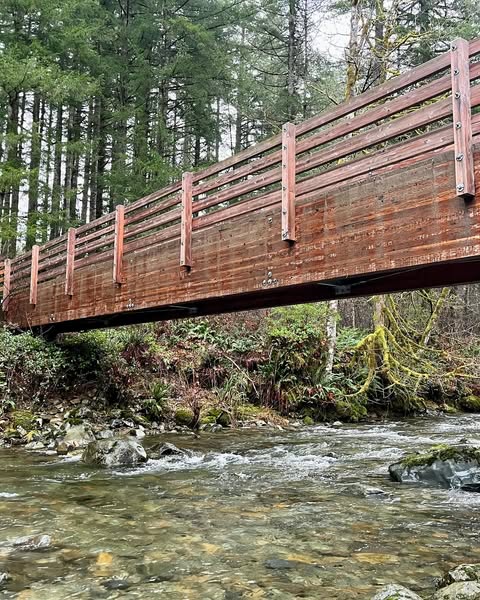
Our family loves this trail as it is rarely busy, there are always cool things to see, and we sometimes see horses! The trail starts out by crossing the creek on a long bridge, hiking through pretty forest (with some impressive nurse logs), and then taking you through a young forest that feels like a wild holiday tree farm. It has been neat to watch the trees grow on this trail over the last 10 years. There are also a lot of large cut stumps that allow for learning about dendrochronology (the study of tree rings). A WA Discover Pass is required to park.
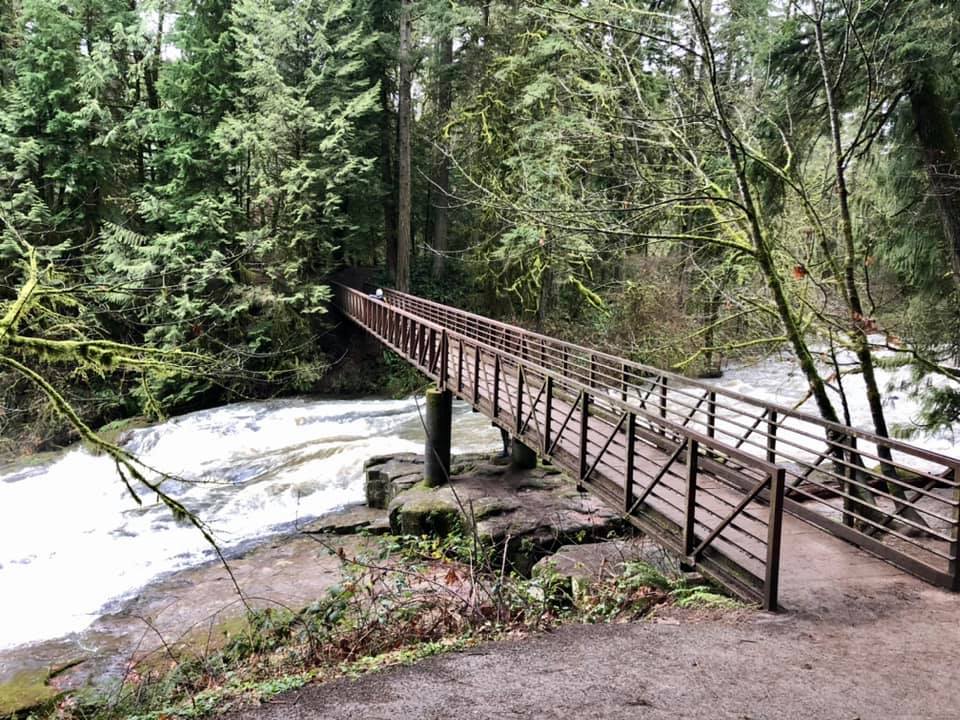
In the winter, there is a lot of water flowing through Lacamas Park and over Lower Falls, which makes it really cool to hike to the falls this time of year. Between the pretty forest, the downed logs that are perfect for climbing, the wide stroller-friendly trail, and the bridge over the rushing creek, it’s a fantastic place to hike with kids. My favorite part of the trail, though, is the rocks. Did you know they are millions of years old? Learn more about that in my book.
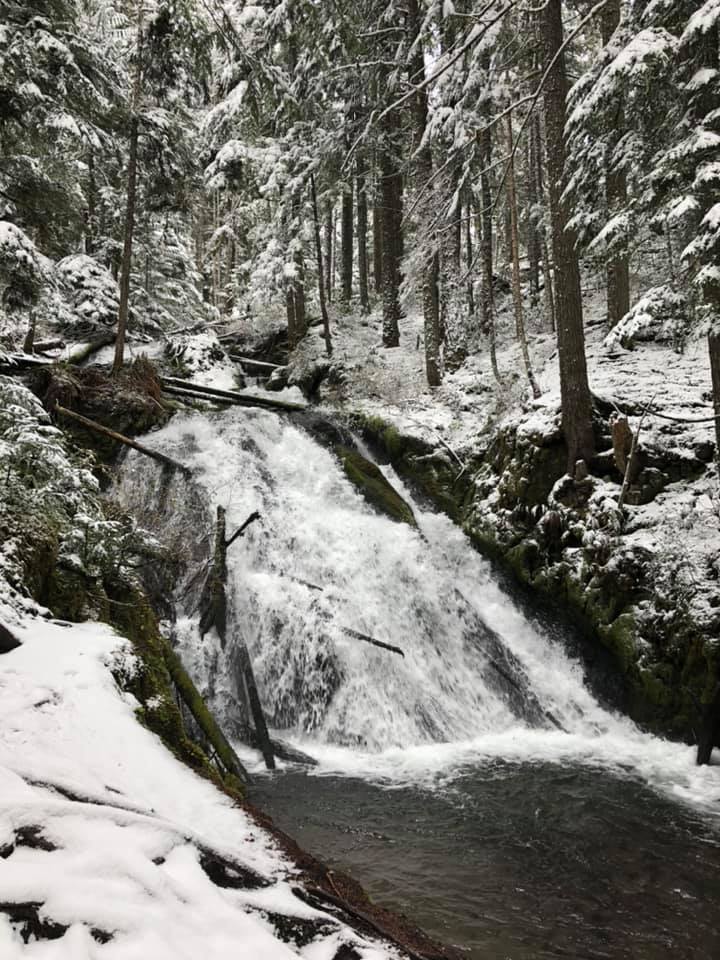
The short hike to Little Zigzag Falls is great any time of the year, but my family really enjoys it when there is just a touch of snow on the ground. The trailhead sits just above 3,000 feet in elevation, so the trail has snow much of the winter. I’m not a huge fan of driving in snow or ice, but the access to this particular trailhead is less challenging than other higher-elevation Mt. Hood hikes. Be sure to read up on winter driving, and follow chain rules. As always, come prepared with your essentials and anything else you might need for a cold, icy/snowy adventure. Thankfully, there is a traffic camera on Highway 26 right by the trailhead. Find the traffic camera for Highway 26 at USFS Rd 35 here.
I love hiking at Wildwood Recreation Area on a rainy day! This awesome BLM recreation area has several miles of flat, kid-friendly trails (most of which are paved or boardwalk) and is located on the west slope of Mt. Hood. This spot is at about 1,200 feet, which means that it should stay snow-free most of the winter. When visiting, be sure to check out the relief map, the river beach, the naturalist exhibits on the boardwalk, and the awesome nurse logs along the paths. FYI, some of the boardwalks can be slippery when wet! There is a fee to park.
If you’ve ever wanted to hike through a fairy forest, the Old Salmon River Trail in Welches is the place to visit. You can hike up to 3.8 miles out-and-back along the river through a mossy old-growth forest. There are multiple parking areas and every section of this trail is beautiful. Plan on playing by the riverbank and climbing on and hugging massive trees. Keep an eye on kids around drop-offs and the swift river. This hike is accessible most of the year, as long as snow levels aren’t too low.
The Columbia River Dike Trail is a popular trail, but you will find fewer crowds in the winter. Winter is a fantastic time to hike, especially on cold, sunny days. Kids always seem to enjoy checking out the interpretive signs, hanging out in the dugout canoe replicas, climbing on low-hanging trees, and birdwatching. You might even see horses along the trail. Look for a view of Mt. Hood to the east on sunny days, and be prepared for windier conditions along the river.
We love this hike because you can hike right up to two waterfalls on a somewhat challenging 2.4 mile loop hike. This hike is a Gorge treasure and is appropriate for kids who can navigate steep trails that are slippery when wet and are narrow with drop-offs. There are great Gorge views as well as fun trees to climb on and walk through. Be prepared for the cold sensations of waterfall spray as you make your way around the loop. The trail can get muddy, so use caution near cliff edges. This is one of the few hikes on the Oregon side of the Western Gorge that has not been affected by the 2017 Eagle Creek Fire. Fire-stricken areas are prone to dangerous mudslides during times of heavy rain, ice, and snow. That said, you still need to pay attention to recent weather events, as they can still destabilize any of the slopes in the Gorge.
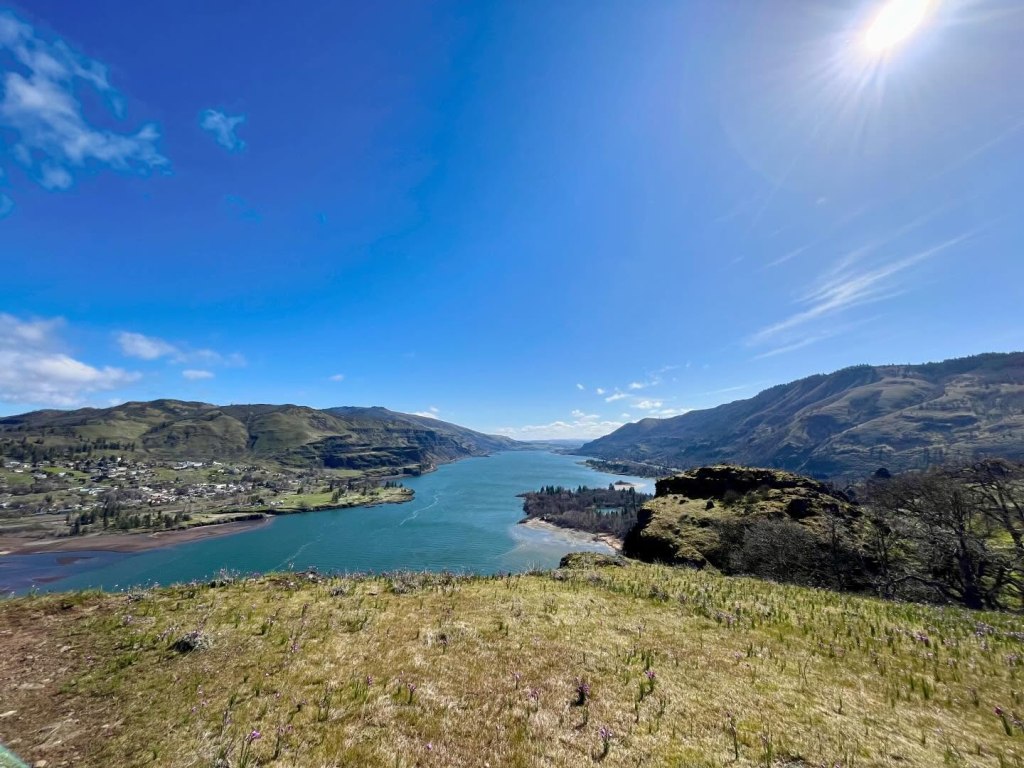
This hike is one of the best in the eastern Gorge for late winter wildflowers. This nature preserve has amazing Gorge views and reliably has purple and white grass widows blooming in late February. In general, the area sees more sunshine in winter due to the rain shadow effect, making its a great destination for the winter blues. Just remember to check the latest forecasts, as the Gorge is prone to ice storms and low-elevation snow during the winter. Please respect this Nature Conservancy property by keeping your pets at home, staying on the trail, not picking the flowers, and using the boot brush at the beginning of the hike. As always when hiking in this part of the Gorge, keep an eye out for poison oak and ticks.
Most people know about amazing Forest Park, but it is hard to know where in the park to hike with kids. This fun loop takes you through a less-crowded section of Forest Park. On your hike, you’ll encounter pretty forest and lots of muddy track traps to help you track any wild animals that may have traversed the trail earlier. Read more about animal track and track traps in my book.
Hopkins Demonstration Forest is a lovely 140-acre privately owned forest near Beavercreek that is open to the public for hiking. There is a variety of trails here that take you past a pond, a creek, a log house, a fire lookout, and more. There are also interpretive features that teach out about the various habitats onsite. I like this property in the winter because there is so much green by way of fir needles, ferns, and other evergreen plants. There isn’t great cell service here, so make sure you know the way before leaving town.
This Metro park is a fantastic place to hike in winter. You’ll often encounter deer amongst the oak savannah and ponderosa pines, and there are interpretive signs along the trail. On a sunny day, you can even spy a view of Mt. Hood. You can hike up to 3.2 miles, and there are some hills to get your blood pumping. Leave some time at the end of your hike to play on the nature playground. No dogs are allowed at this park.
I hope you have a wonderful winter season out on the trails. Be safe and have fun!Be sure to follow little feet hiking on Facebook and Instagram for trip reports.
Fall is personally my favorite season in the Pacific Northwest. The snow level tends to hang high enough into early October to still get up into the mountains, and the mushrooms and changing leaves can be so colorful. We also get to enjoy less-rainy outdoors adventures with less heat, less smoke, and fewer mosquitoes. My favorite part, however, is all the opportunities to see salmon spawning.
little feet hiking books have some great information on hiking in the fall. Read on for mom-tested tips on where to hike with kids in the fall, as well as how to hike safely with kids.
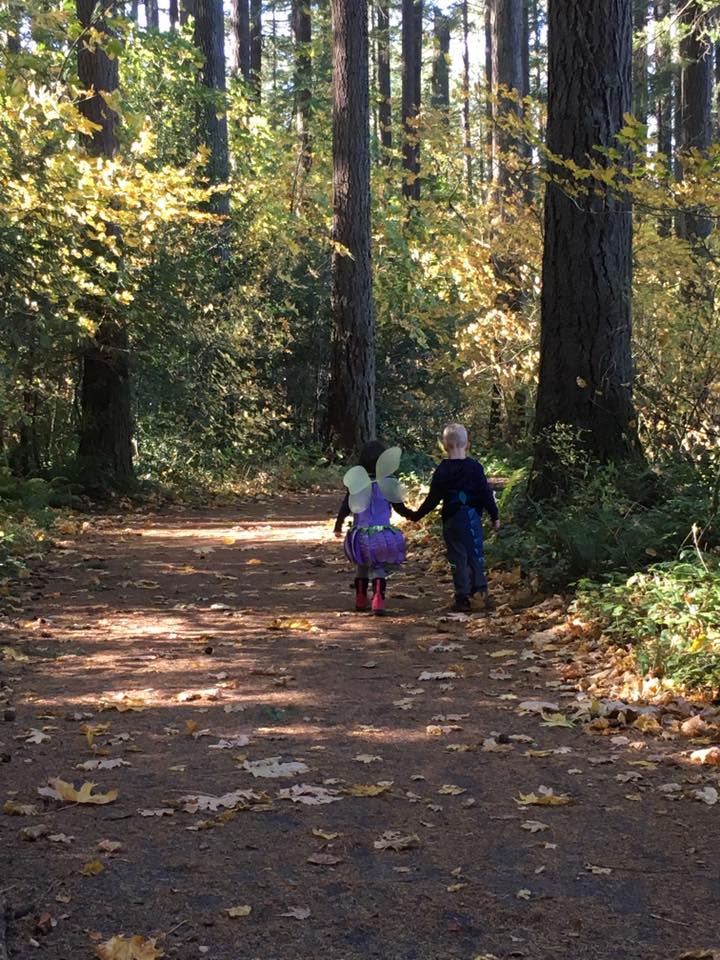
October is the perfect time to hike in costume
What makes hiking in the fall so special?
Trails tend to be less crowded and it’s easier to connect with one another on a trail. Once kids go back to school, staying connected to nature is more important than ever and is actually quite helpful to their studies. Despite the busyness that fall brings, make sure to keep some routines of connecting with nature. Even a walk around the neighborhood can lead to nature discoveries.
The sun is setting earlier, but our nights are still mostly clear. This is a great time to introduce younger kids to stargazing. Consider a hike at dusk and watch the stars come out. For the best stargazing, find a spot away from city lights and start looking for stars about a half hour after sunset. Search for your location and find sunset times here.
It has been a bad year for mosquitoes and they are finally starting to die down. This makes it a great time to get into the higher elevations above 4,000 feet, where huckleberries are ripe and leaves are changing colors. We usually have till at least mid-October before snow starts falling this high. Consider checking out some higher-elevation hikes on Mt. Hood or in the Indian Heaven Wilderness in SW Washington. That said, keep an eye on the forecast – snow levels should start dropping soon!
Campgrounds are starting to close, but there are a few places like Lost Lake, where you can camp through mid-October. Also, many state park campgrounds allow camping year-round and this shoulder season is a great time to camp with fewer crowds and great weather.
Here are a few tips for fall hiking:
Plan for quickly changing weather. Check the weather the morning of your hike, but make sure you have extra layers for rain, wind, or hail.
Dress in layers and avoid cotton. The combination of cool fall temperatures and rain can still put you in hypothermia territory.
Now that you know how to hike in the fall, how do you know where to hike with your family? No worries, I’ve got you covered. I’ve compiled my favorite fall hikes by book. Check them out below.
I love this hike for the falling heart-shaped cottonwood leaves and the chance to see birds preparing for winter. Leaves start changing colors in mid-October and are usually off the trees by mid-November. This 2.5 mile hike is appropriate for new hikers through adults.
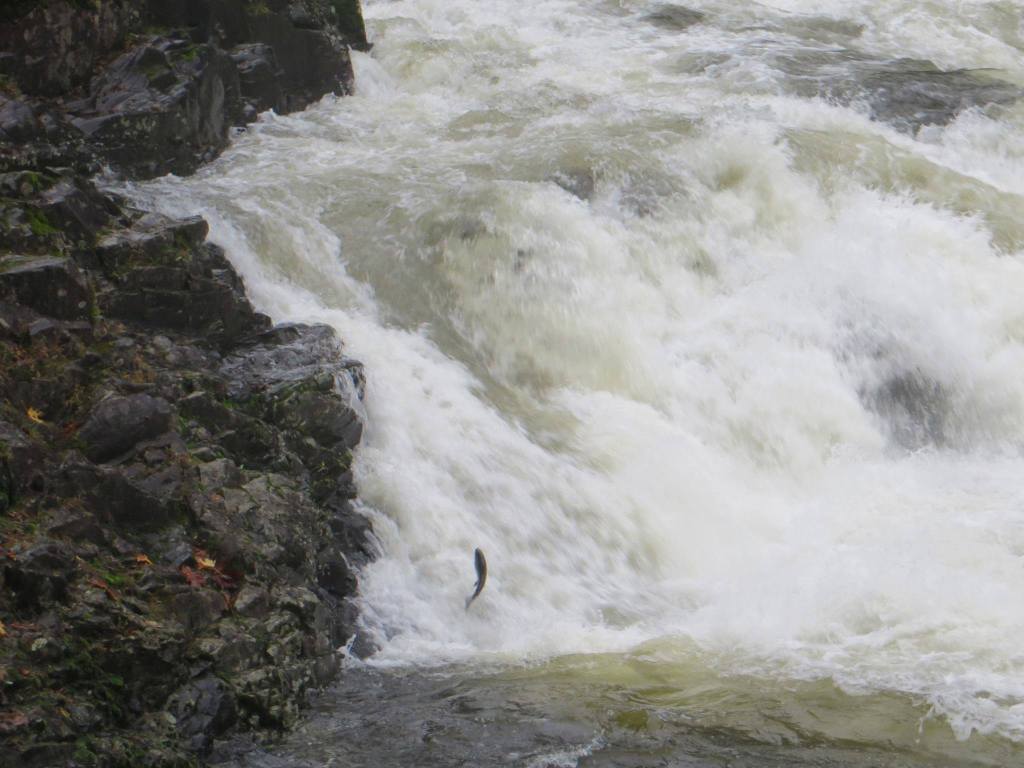
Lucia Falls is a year-round favorite for our family, but we especially love it in October for the salmon run. Check out this video and this post to see salmon jumping there in October. Along this short hike, you will also see lovely changing falls colors and neat mushrooms. Consider visiting on a weekend in October so you can check out Pomeroy Farm’s Pumpkin Lane after your hike. This 1 mile hike is appropriate for all ages, although littles will need help staying away from the rocks and walking through the parking lot.
The forest at Whipple Creek Regional Park is such an urban oasis for the area. The forest is beautiful year-round, but especially mid-October to mid-November when the big-leaf maple tree leaves fall. The trail itself is okay for all ages, but littles will need help if you encounter horses. The trails can be a bit confusing, so check out the 1 to 2.4 mile routes outlined in the book.
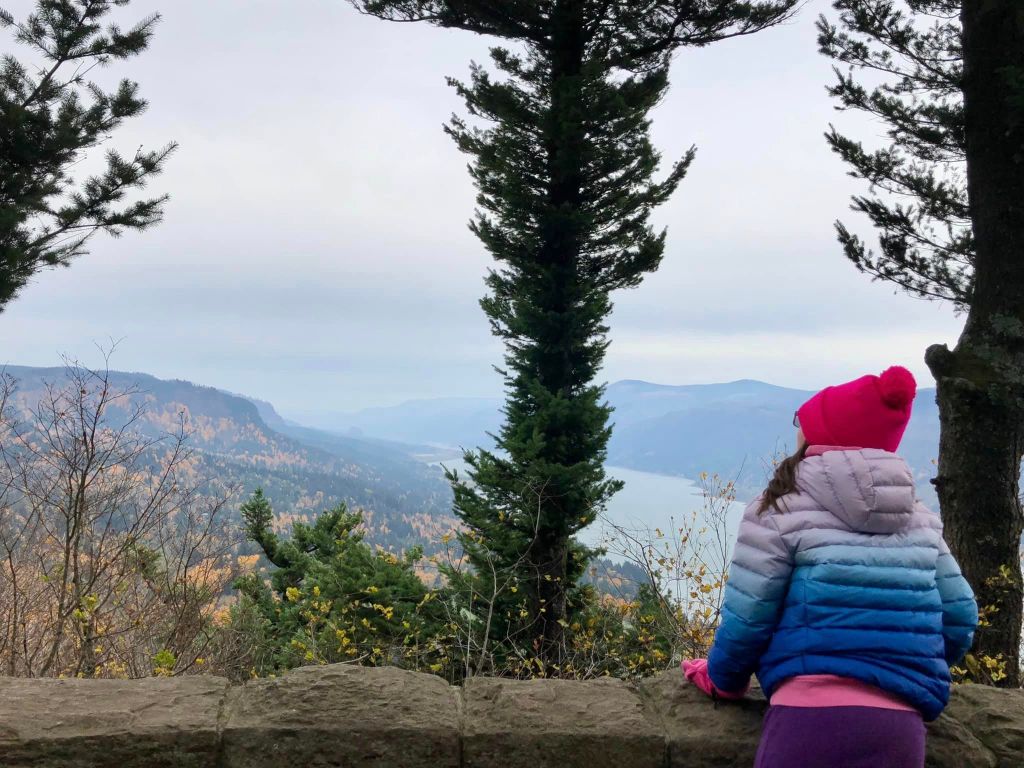
The Cape Horn area of the Columbia River Gorge is one of the best places to see fall colors. The problem is that most of the area isn’t too kid-friendly due to drop-offs. In little feet hiking, I’ve outlined a more kid-friendly 1 mile hike to a walled overlook of the Gorge. For a longer hike to this same spot, check out the Cape Horn hike in little feet hiking: Columbia River Gorge.
The Whistle Punk trail is located in the Gifford Pinchot National Forest near Carson, so it requires a little bit of a drive. However, the drive through the Gorge and into the forest is quite lovely, and this trail also features some neat historical equipment interspersed throughout the forest. Consider tacking on a trip to the Bonneville Fish Hatchery to see adult fall Chinook and coho salmon spawning. This 1.9 mile hike is appropriate for all ages.
The 1.8 to 4 mile hike on the Thomas Lake trail is one of my absolute favorites in the fall. It is hard to hike into the Indian Heaven Wilderness most of the year due to snow and heavy mosquito populations. Late September into October is perfect up there – you’ll encounter pretty fall colors, cool and crisp weather, colorful mushrooms to identify, and maybe even some lingering huckleberries. The drivetime to the trail is longer than other hikes in the book, but this one is worth it.
The 2.4 mile round trip hike to Goat Marsh Lake is one of my favorite hikes on the south side of Mt. St. Helens. In addition to hiking through ancient lava flows, you’ll have a chance to see an epic view of the volcano. Fall is special in this spot because the mosquitoes have died down (it is a marsh after all), and you are likely to see lots of frogs and colorful mushrooms.
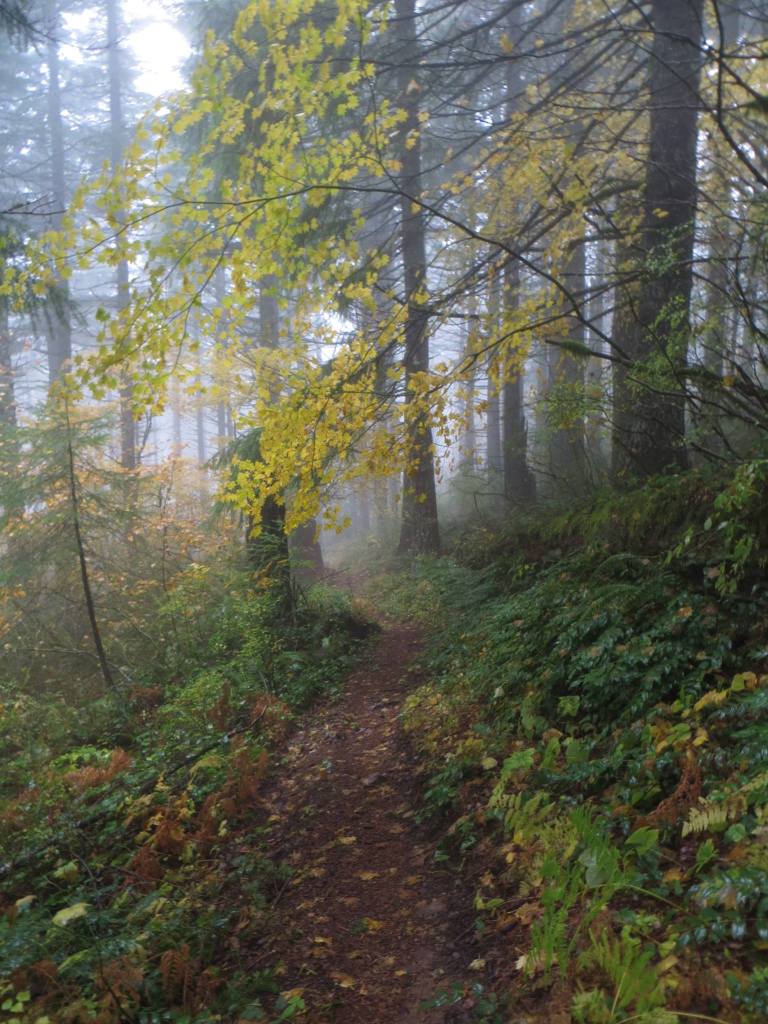
This 3 mile off-the-beaten-path hike doesn’t have any grand vistas, but the forest is so quiet and the fall colors in October and November are quite pretty. The hike is especially cool in foggy weather. This hike is doable for any kid that can deal with steady elevation gain, hike safely on a gravel road for a few minutes, and can either cross independently or be carried over some minor water crossings.
The CASEE trails are the perfect place for a mellow fall hike with your family. On the 1.1 mile hike, you’ll walk through an arboretum with many native and non-native deciduous trees, and then you’ll dip into a native fir forest full of neat and interesting mushrooms.
Battle Ground Lake State Park is a busy place in summer, so I like to visit in the fall when leaves are changing and crowds are sparse. Hiking around the lake also provides an opportunity for some place-based learning. You can learn about the volcanic origins of this lake in my second hiking book. Littles may find this trail challenging at times due to rocks on the trail – and then there is the lake:)
This short, flat hike is another place where place-based learning can occur. This hike not only has tons of historical connections, but you also get some neat views of Bonneville Dam. Consider hiking this trail in November for fall colors and to honor Native American Heritage Month. Along the trail, you will find signposts that correlate with an online brochure detailing what each signpost. Unfortunately, much of the information you will find about this trail focuses on the western settlers and how they built forts to protect the portage from the people who once lived here. Before this land was taken in the 1850’s, the Fort Cascades Loop Trail was occupied by members of the Watlala and Cowlitz tribes. Before or after your hike, educate your kids on the people who lived here before it was taken. While this trail works for all ages, littles will need help staying off the historical equipment.
This hike takes you to subalpine meadows with a lovely lake. Late September and early October are the best time to hike if you want to see changing fall colors and colorful mushrooms (look, don’t touch!). Keep an eye on changing snow levels as the trailhead is located at 4,100 feet. This trail is appropriate for all ages.
If you’re looking for fall colors, look no further than the 2.8 mile trail at Lewisville Park in Battle Ground! This easy trail is practically empty on a cold, wet day. Just keep your kids far away from the rushing, swollen East Fork Lewis River.
October is a fantastic time to hike the Ape Cave surface trail. The vine maple leaves are changing to a vibrant red, fun mushrooms start popping up in the forest, and you can hike along the trail through the lava fields without getting overheated. You can also explore the cave with smaller crowds (I recommend the lower cave for kids). Timed parking reservations are still required. I would avoid this with littles because it is easy to get scraped up on the lava field or fall in hole.
Barlow Wayside is a lovely place to see changing fall colors, but it is also known as a great place to watch spawning salmon late September to early December.. You can learn about where to look for the salmon in my Mt. Hood hiking guide. This hike is appropriate for all ages, but you will want to keep littles out of the creek to protect the salmon.
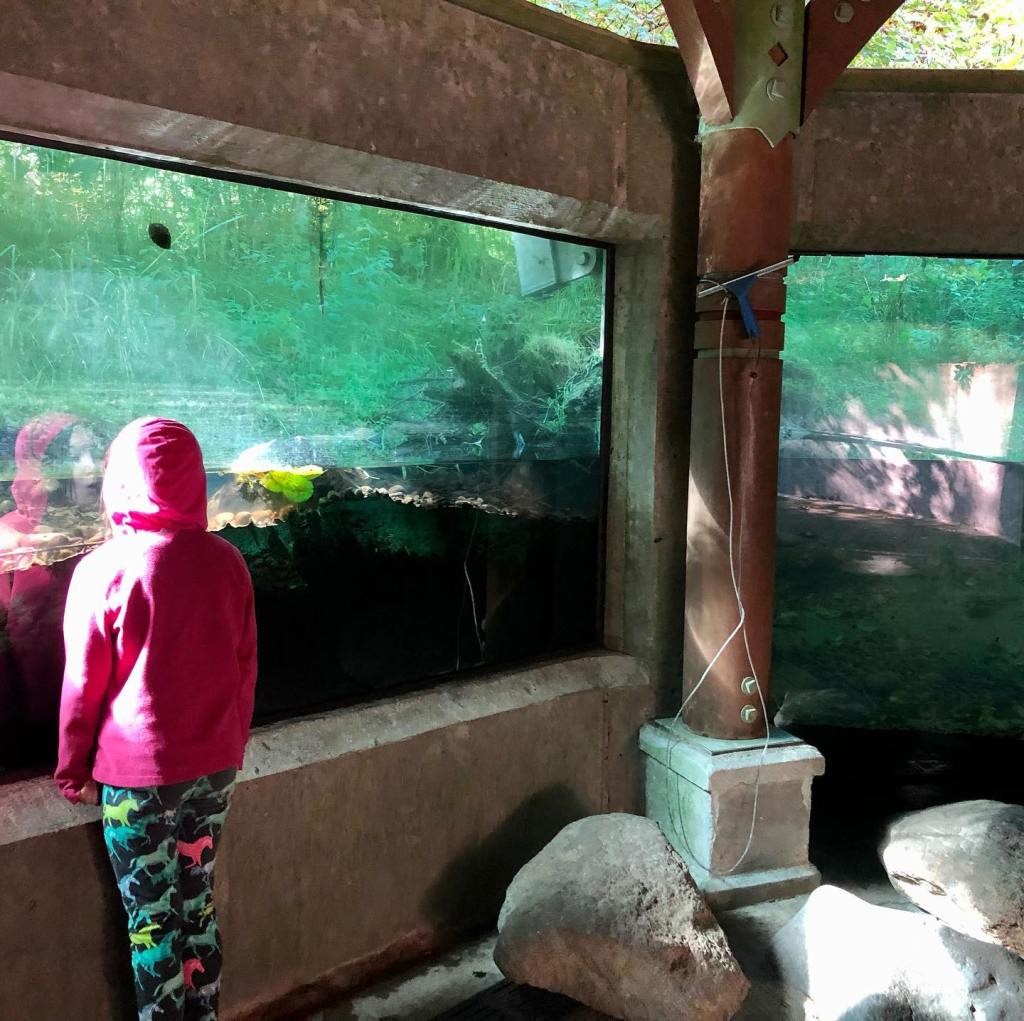
The Wildwood Recreation Site in Welches is such a neat place. If you visit in the fall, you will definitely see changing falls colors, but you are also likely to meet some small fry at the fish viewing window and see salmon spawning in the Salmon River from late August through November. This hike is great for all ages.
The 4 mile out-and-back hike on the Salmon River Trail is excellent in the fall. You’ll see spawning salmon, changing fall leaves, and lots of mushrooms. There are some drop-offs and the trail can be slippery when wet, so this hike is best-suited for more confident older hikers.
Lost Lake is a family favorite for fall hiking and camping (open through mid-October). The lake trail is flat and offers excellent views of Mt. Hood and changing fall colors. You can even rent boats on-site through the middle of October. This hike is appropriate for all ages, but littles will need help staying out of the lake and crossing campground roads.
One of my favorite places to hike in the fall is Cape Horn on the Washington side. It’s so close to town and the fall colors are amazing…unfortunately many of the trails around Cape Horn are not kid-friendly due to drop-offs and cliff top viewpoints with no barriers. My first book outlines an easy and flat 1-2ish mile round trip hike that takes you to an awesome overlook with barrier walls. My Gorge book includes a longer and steeper (but not too steep) 3 mile hike that takes you to multiple viewpoints and through a neat tunnel (you can see some of the viewpoints and the tunnel on a shorter, less steep option too). Both are more kid-friendly (there are still risks and caution will need to be used near roads and cliffs) but you won’t find either of these kid-specific hiking routes described anywhere else.
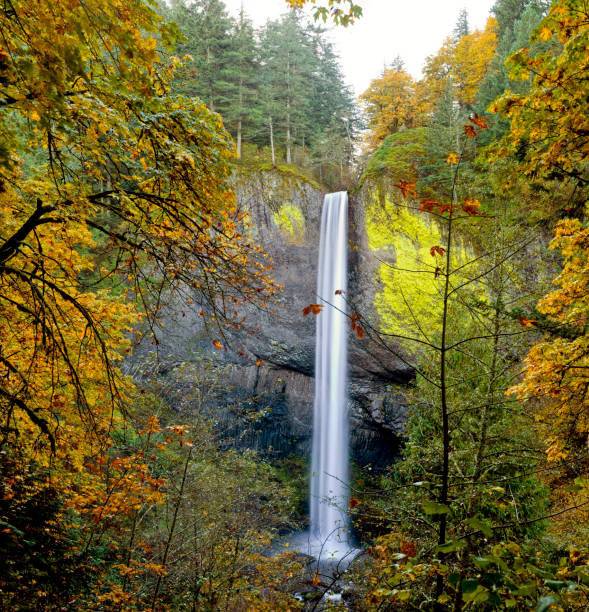
Latourell Falls in the Columbia Gorge, taken in Oregon in Autumn. Taken with a medium format film camera.
This 2.2 mile hike takes you past several waterfalls and is one of the few kid-friendly Gorge trails not impacted by recent wildfires. In the fall, the changing colors are magnificent and so are the mushroom sightings. There are some drop-offs and the trail can be quite slippery when wet.
One of the best places in the area to see salmon spawning is in Eagle Creek by the Cascade Salmon Hatchery. I don’t think the infamous Eagle Creek trail is safe for most kids, but I’ve crafted a more kid-friendly hike starting at this trailhead and passing one of my favorite salmon spawning viewing spots. The best time to see salmon spawning here is late-September to mid-October. This hike is okay for all ages but littles will need help staying out of the creek, walking through the parking lot, getting to the bottom of the waterfall, and not falling over the bridge above the waterfall.
The hike to Pool of the Winds is one of my favorite trails, but it can be hard to hike in the summer due to its popularity. As we move into October and November, the trails should be less busy and it should be easier to find a parking spot so you can get those amazing Hamilton Mountain and waterfall views. This hike’s elevation gain can be challenging on little legs and there are some drop-offs, so I recommend this hike for sure-footed hiker kids.
I love the Columbia River Highway Trail heading west from Starvation Creek State Park because of its lovely waterfalls and it’s accessibility. The trail is paved, making it okay for strollers and even bicycles. As we move into the rainy season, the waterfalls will get fuller and colorful leaves will drop to the ground. It can be quite noisy due to the interstate, FYI. This hike is appropriate for all ages.
On the west side of the Columbia River Gorge, most of the leaves we see changing and falling come from big-leaf maple trees. On the east side, the most dominant deciduous tree is the mighty white oak tree. While hiking along the Catherine Creek trail in October and November, you’ll be struck by the contrast of the brown/orange oak leaves against the blue sky (because it is sunnier there than it is on the west side). This hike is best for older hikers due to elevation gain, drop-offs, and rattlesnakes (staying on the trail is the best way to avoid them).
This trail on Sauvie Island is excellent in fall. On a typical hike in fall, you should see birds, caterpillars, frog, snakes, and maybe even some deer or crickets. If you visit in October, I highly recommend following your hike up with a trip to one of the island’s wonderful pumpkin patches. This hike is okay for all ages, but littles will need help near water.
Lacamas Park is lovely in the fall with lots of falling colorful leaves. There are many trails here, but my book outlines a 1.4 mile and 2.5 mile loop depending on how far you’d like to hike. Highlights include the lake, the dam, and some very cool rocks!
You don’t hear much about the hike around Reed Lake, but its an absolutely lovely place for a hike and nature connection. My favorite part of hiking here is the opportunity to see wildlife up close. The City of Portland and Reed College have been working tirelessly over the years to restore Reed Lake and Crystal Springs Creek to its former, healthier self. Because of this, last October (while scouting for the Portland book), my daughter and I watched an otter eat a fish in the lake. 3 miles from downtown Portland! I can’t guarantee an otter sighting, but as this area gets healthier and more salmon return to the area in fall, your chances get better every year. Learn more about the restoration work and the hike itself in my Portland book. This hike is okay for all ages, but littles will need help near water and when walking on the road.
Oxbow Regional Park is known for its fall salmon viewing, as well as its beautiful forest. My book outlines several hikes you can do, but this brochure is the best for understanding the annual salmon run. When you visit, be sure to leave enough time for kids to play on Oxbow’s two playgrounds. This hike is okay for all ages, but littles will need help with road crossings and staying out of the rushing and dangerous Sandy River.
Springbrook Park has 1.2 miles of flat trails that are perfect for all ages. The park is full of big-leaf maple trees, and those trees will certainly drop large yellow leaves in the fall. Be sure to leave some time for kids to play on the nature play area inside the park.
Hoyt Arboretum is one of the best places in the area to check out the changing seasons, especially the change from summer to fall. The arboretum’s massive deciduous tree selection is sure to put on a great show every October and November. Check out the website for seasonal activities and little feet hiking: Portland Metro for several kid-friendly loops through these changing trees. This hike is great for all ages.
One of the most amazing natural wonders we encounter in the Pacific Northwest is the annual fall salmon run. Salmon need cold, clean water and large amounts of gravel or sediment to lay their eggs (spawn), which is why you’ll encounter them in some of our local creeks and rivers. Salmon spawn at the end of their lives – they spend 3 or 4 years out in the ocean before swimming back to the freshwater area where they were born. Watching fish complete this instinctual cycle is a sight to behold, and thankfully there are some kid-friendly places in the Portland-Vancouver area where families can witness this wonder.
Below is a list of the best places to take kids to see salmon spawning in the fall. Be sure to pick up a copy of the relevant little feet hiking guide to give you the best information for a safe, educational, and fun salmon-watching adventure.
P.S. Salmon poisoning is a thing for dogs. Look into this and keep dogs away from spawning areas for their safety.
Lucia Falls Regional Park
Easy stroller-friendly hike is appropriate for all ages, although littles will need help staying away from the rocks and walking through the parking lot
You will see salmon jumping the falls starting in late September and through the end of October at least (sometimes you’ll see into December)
Check out this video and this post to see salmon jumping there in October
You’ll also encounter lovely changing falls colors and neat mushrooms
Easy hike is okay for all ages but littles will need help staying out of the creek, walking through the parking lot, getting to the bottom of the waterfall, and not falling over the bridge above the waterfall
The hike starts from the Eagle Creek trailhead, which is one of the best places in the area to see salmon spawning
The Eagle Creek trail is not kid-friendly, but I’ve crafted a more kid-friendly hike starting at this trailhead and passing one of my favorite salmon spawning viewing spots
Best time to see salmon spawning here is late-September to mid-October
Mt. Hood with one of my favorite wildflower (western pasqueflower) in the foreground
I’ve recently discovered a new kid-friendly hiking route on Mt. Hood, and I just had to share it. I wish I had known about it before I had published little feet hiking: Mt. Hood, but at least I can share it with you here!
Hike Description for the Mt. Hood Meadows Timberline Loop:
Level 3
Trailhead Elevation: 3,720 feet
3.3 mile loop
Around 650 feet of elevation gain
Open summers
Popularity: Low on weekdays and Medium on weekends
Why Should You Check Out This Hike? This hike really has it all – amazing floral displays, creeks and a small waterfall, and mountain views. If you visit on a day that the lodge is open, there is also a restaurant and flush toilets available. There are no major drop-offs, but you may get your feet wet while crossing the creeks.
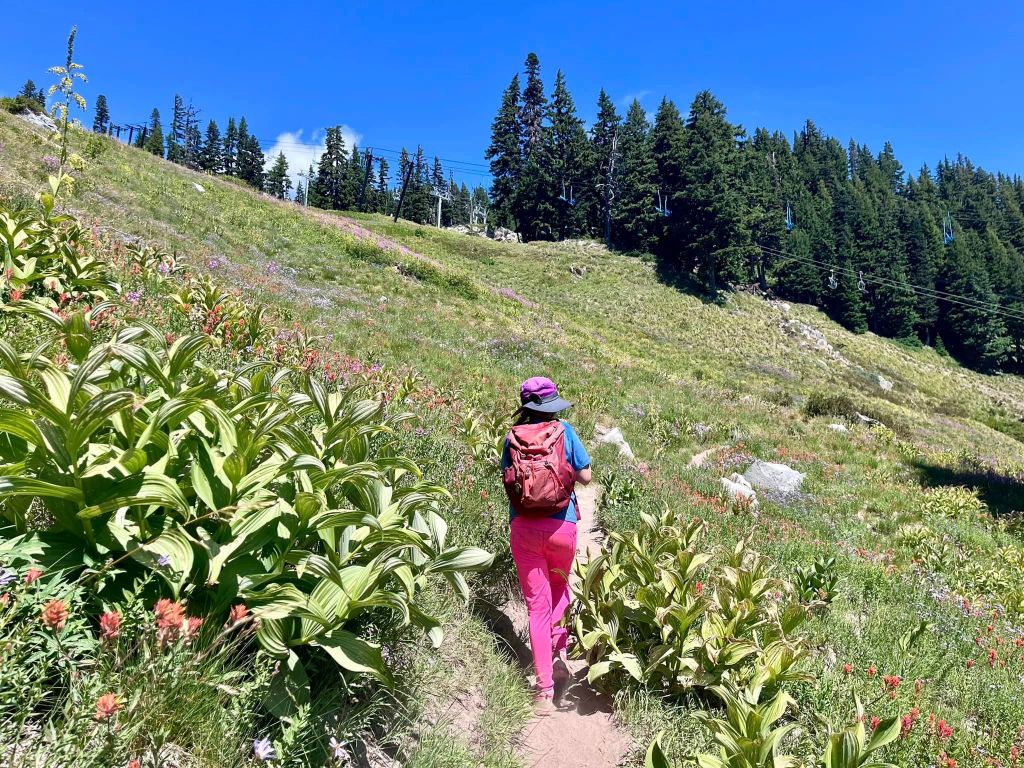
Kiddo hiking past false hellebore and paintbrush
Ways to Engage Your Kids:
Bring a field guide to identify summer flowers like lupine, paintbrush, beargrass, Douglas aster, goldenrod, false hellebore, and western pasqueflower
Play in the creeks
Pick huckleberries at the end of the summer
Look for Mt. Jefferson to the south
Checking out Pencil Falls
Trail Description:
Walk towards the lodge and then walk alongside the building on its right side. Pass a little playground on the left, and then stay right at a junction. Continue following the service road as it heads towards the mountain and then hike right on Beargrass Trail #1 (see the map here). Follow the trail through meadows and under a ski lift before climbing a bit up to a junction with a service road. Turn left onto the service road and hike uphill. Stay on the road as you pass a service road on the left. At a junction, head left onto a different service road. Come to a junction with the Timberline Trail at 1.1 miles into your hike.
Head left (west) onto the Timberline Trail. This is where the hike gets really fantastic. On this trail, you will hike through a few creek crossings, past a pretty waterfall called Pencil Falls, in and out of colorful meadows, and alongside large rock walls. Hike on this trail for 1.1 miles before coming to a junction with a service road. Just past this junction, you will see a junction with the Umbrella Falls Trail. Turn left onto this trail. Hike through lovely woods and wildflower meadows for about 0.9 miles before coming to a junction with a trail. Go left onto this trail to head back 0.25 mile to the west side of the lodge.
After your hike, you can add on a short trip to Umbrella Falls (Hike #33 in little feet hiking: Mt. Hood) by heading to the southeast corner of the parking lot. Find a trail marked for the waterfall and follow this trail for about 1,000 feet before coming to Umbrella Falls.
Checking out Umbrella Falls
Important Things to Know:
Seasons: These trails are only open in the summer; confirm seasons here
Conveniences: Restrooms and restaurant inside the lodge, which is open Thursday through Monday; confirm hours here
Toilets: Restrooms available inside lodge on open days; the closest vault toilet is available at the Bennett Pass Trailhead 2 miles away
Risks specific to the trail: Mosquitoes early in summer; high altitude; sun exposure; lots of pollinators like bees; work vehicles on the service roads; creek crossings
Recommended extra gear: Mosquito repellent early in early summer; extra water; sun protection
Trailhead GPS coordinates: 45.329750, -121.662738
Driving directions: From the Highway 26/Highway 35 interchange, drive east on Highway 35 for 6.1 miles. Take the exit toward Bennett Pass and Mt Hood Meadows, staying left as you exit. Continue onto Mt. Hood Meadows Drive for about 1.5 miles to the parking lot. The lodge’s parking area is not open to the public on Tuesdays and Wednesdays, so on the those days you will need to park on the side of the road just outside the gated entry to the parking lot.
Pretty forest along the trailMt. Jefferson, as seen from the trailHike under these ski lifts
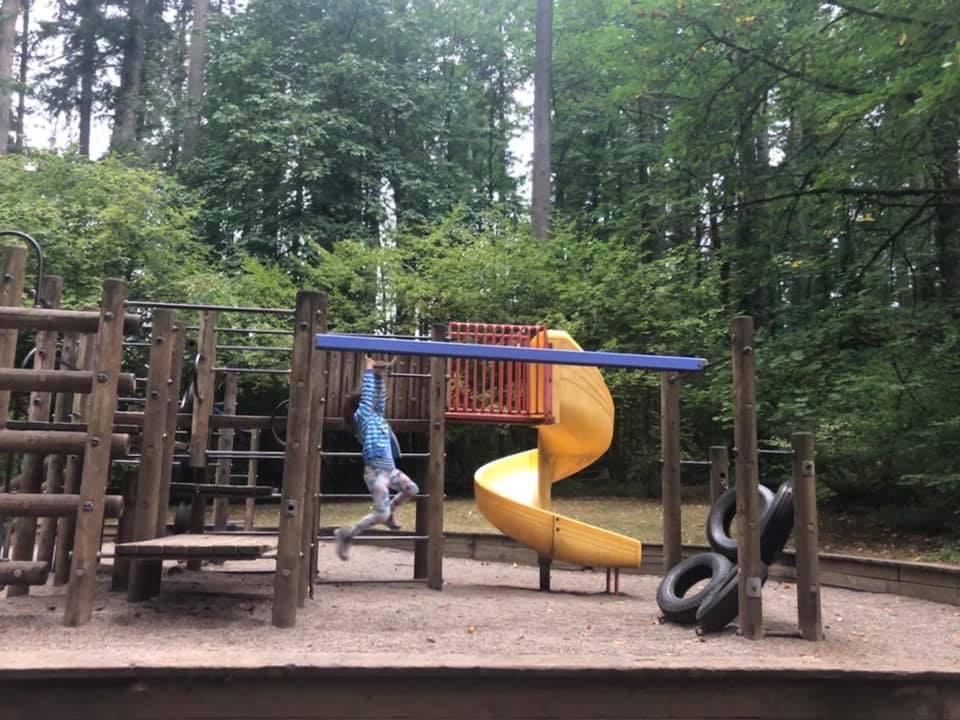
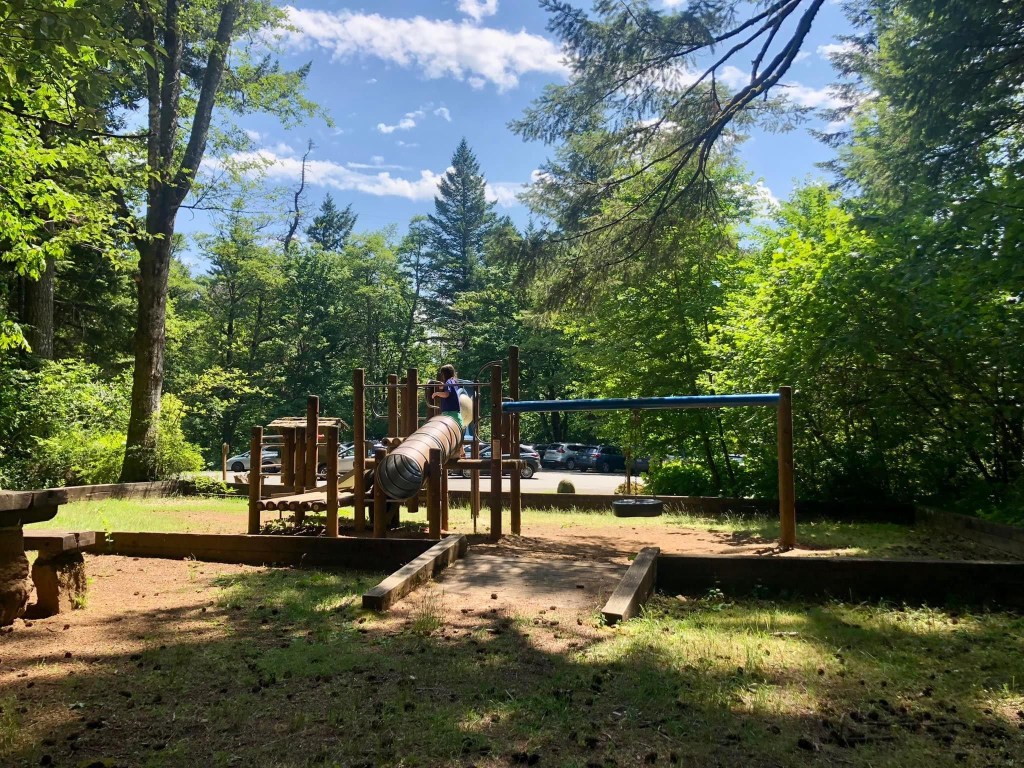
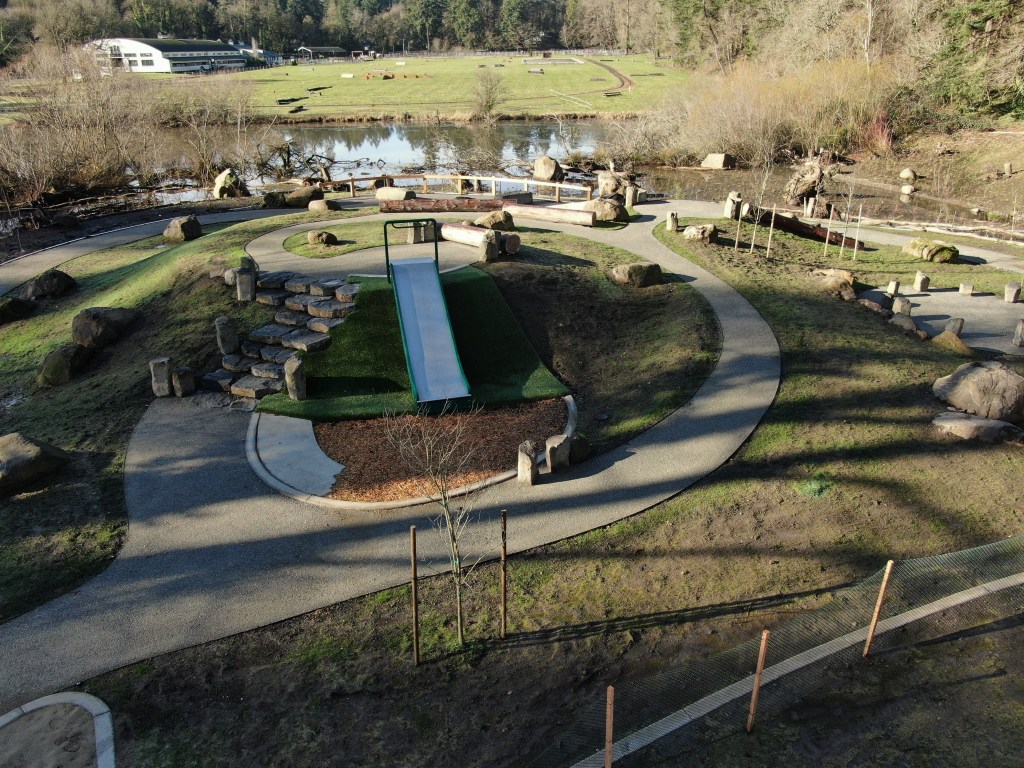
Have you ever hiked with a kid who just didn’t want to hike? It happens. In my five hiking guides, I give you a lot of general and hike-specific ideas to motivate your kids to keep hiking. However, after 10 years of hiking with kids of all ages, the most tried-and-true motivator that I’ve found (other than ice cream) is PLAYGROUNDS!
North Bonneville Park
After going through all 5 of my kids hiking guides, I’ve identified 22 hikes, within 50 miles of Portland (Oregon) and Vancouver (Washington), that have playgrounds along the trail, at the trailhead, or within a few miles of the trailhead. Better yet, my 10 year old (the original littlefoot) sat down with me to rank the top 10 playgrounds in her opinion (she has visited all of them).You can find that post here. Below you will find the remaining 12 playground hikes!
12 MORE PLAYGROUNDS (AND THEIR HIKES)
Tickle Creek
1.6 to 3.2 miles round trip
Shallow creeks
Paved or gravel, stroller-friendly trails
29 miles from downtown Portland and 32 miles from downtown Vancouver
Bells Mountain Trail from Cold Creek Day Use Area, “little feet hiking”
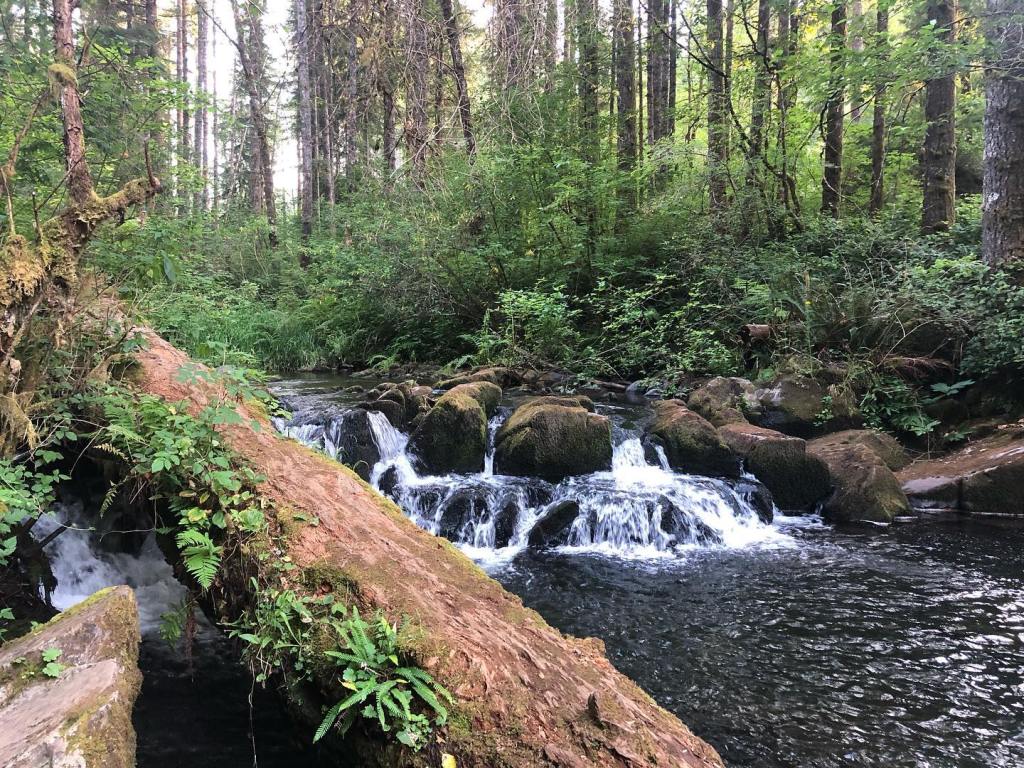
The heat is here and people will be flocking to our local waterways. In addition to being crowded, our waterways aren’t the safest places during the rapid snowmelt that comes with our first few heat waves of the year. The water can be cold and fast-moving, and many places do not have lifeguards available. So how do you keep your kids active during a heat wave? The awesome thing about our area is that we have so many amazing forests that can keep us cool on the hottest days. Did you know that shady forests can keep us cool through what is known as the process of evapotranspiration?? While forests can help keep you cool, you will still need to take it easy and keep an eye out for signs of heat exhaustion or stroke. Hitting the trail in the morning and bringing along extra water and sun protection is helpful too.
Below are some suggestions of hikes that should be shady, less-crowded, and keep you away from the big bodies of water. If you are going near any body of water, it is good to brush up on your water safety skills and assess the risks for your entire family before enjoying any water. Even small creeks can present issues for certain kids. Be safe, and access water on the following hikes at your own risk.
Have you ever hiked with a kid who just didn’t want to hike? It happens. In my five hiking guides, I give you a lot of general and hike-specific ideas to motivate your kids to keep hiking. However, after 10 years of hiking with kids of all ages, the most tried-and-true motivator that I’ve found (other than ice cream) is PLAYGROUNDS!
I have gone through all five of my books, and I’ve identified 22 hikes, within 50 miles of Portland (Oregon) and Vancouver (Washington), that have playgrounds along the trail, at the trailhead, or within a few miles of the trailhead. Better yet, my 10 year old (the original littlefoot) sat down with me to rank the top 10 playgrounds in her opinion (she has visited all of them).
Below, you will find these top 10. Click here for the remaining 12!
TOP 10 PLAYGROUNDS (AND THEIR HIKES) ACCORDING TO LITTLEFOOT




 , but that will take a few weeks.